Advertising Watershed
Ireland has closed most of the broadcast day to gambling advertising and rebuilt the online side around consent instead of the clock. This page sets out what the rule says, when it applies, who enforces it, and the things people keep getting wrong about it.
The short answer
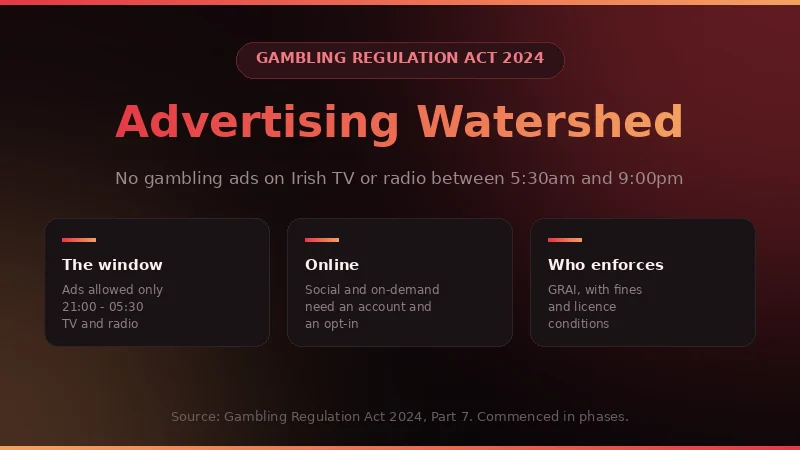
Under the Gambling Regulation Act 2024, gambling ads cannot be broadcast on Irish television or radio between 5:30am and 9:00pm. Ads are permitted only in the overnight window. Online is governed by consent rather than time: on social media and on-demand platforms you must hold an account and have opted in before a gambling ad may be served to you. GRAI enforces both.
What the Rule Actually Says
The watershed is a straightforward time bar on broadcast media. Gambling advertising may not be shown on television or broadcast on radio between 5:30am and 9:00pm. Everything outside that window — the small hours — remains open. The intent stated throughout the legislative debate was to keep gambling advertising away from the times children are most likely to be watching or listening, which is why the bar starts before the school run and lifts after the watershed most Irish broadcasters already recognised.
Broadcast: a clock rule
TV and radio. No gambling ads 05:30–21:00, full stop, regardless of the programme or the audience. Simple to apply and simple to police, which is the point of drafting it as a time bar.
Online: a consent rule
Social media, on-demand and media-sharing services. An ad may only reach someone who has an account on the platform and has opted in to receiving gambling advertising there. A time-based rule makes little sense on a feed you scroll at any hour, so the Act uses permission instead.
Alongside the timing and consent rules, the Act sets content requirements that apply whenever an ad is permitted. An advertisement must not be aimed at children, must not encourage excessive or repetitive gambling, and must not misrepresent the social or financial benefits of gambling. The Authority also has power to go further — to prescribe times, places and events where ads may appear, and to cap their frequency and duration.
Sponsorship is treated separately and more narrowly than some of the headlines suggested. The strictest limits attach where children are involved: teams, events and activities aimed at under-18s. Adult sports sponsorship was not swept away by the watershed itself, which is why you will still see gambling branding around senior fixtures.
Timeline of the Changes
23 October 2024
Gambling Regulation Act 2024 signed into law
The first comprehensive replacement for a framework that dated back to 1956, covering licensing, advertising, inducements and a social impact fund in one Act.
4 March 2025
First commencement order signed
The Gambling Regulatory Authority of Ireland is formally established and begins standing itself up as a regulator.
February 2026
Licensing opens for remote betting
A further commencement order brings key licensing provisions into force and the B2C application portal opens on 9 February.
1 July 2026
First GRAI licences issued
Remote betting and betting intermediary licences start being granted. Operators serving Irish customers need to be licensed to continue.
December 2026 onwards
In-person licensing, then further phases
Retail licensing follows, with gaming, lotteries, B2B and charitable licences phased after it. Remote gaming has not opened as this page was last checked.
What It Means for You
If you never wanted the ads, the daytime change is the one you will notice: no gambling spots during racing coverage, the news, or drive-time radio. If you follow bookmakers or casino accounts online, you will probably notice very little, because you have already opted in by following them. That is the rule working as intended rather than a loophole — the Act deliberately draws the line at consent rather than trying to scrub the internet.
There is a subtler effect worth naming. When advertising is restricted, the offers do not disappear; they move to channels where you have already given permission — email, push notifications, the operator's own app and site. If you find that offers now feel more personal and better timed, that is because the surviving channels are the targeted ones. Marketing preferences in your account settings are the switch that actually controls this, and they are usually a separate toggle from the platform-level opt-in.
The Act also restricts certain inducements — the free-bet-if-you-deposit-more style of offer aimed at increasing spend. That is a distinct set of provisions from the watershed, and it is being phased in with licensing rather than switching on all at once.
Before and After
| Channel | Before the Act | Under the Act |
|---|---|---|
| TV and radio | Permitted all day under voluntary codes | Prohibited 05:30–21:00 |
| Social media | Broad targeting, platform rules only | Account plus opt-in required |
| On-demand video | Treated much like online display | Same consent requirement as social |
| Ad content | Industry self-regulation | Statutory content rules, enforceable |
| Sponsorship | Largely unrestricted | Restricted, tightest where children are involved |
| Enforcement | Advertising complaints bodies | GRAI, with licence conditions and sanctions |
Myths and Misreadings
“Gambling ads are banned in Ireland.”
No. They are barred from broadcast for most of the day and gated behind consent online. The overnight broadcast window remains open, and permitted ads still run.
“Social media advertising was banned outright.”
An outright ban was floated during the Bill's passage and did not survive into the final text. What emerged was the account-plus-opt-in model, which is a meaningfully different thing.
“All gambling sponsorship of sport is over.”
Sponsorship is restricted, not abolished. The hard limits attach to children's teams, events and activities.
“The whole Act came into force in 2024.”
It was signed in October 2024 and is being commenced in stages by ministerial order. Different parts switch on at different times, which is exactly why dates matter on this topic.
“A casino advertising to Irish players must hold an Irish licence.”
Remote gaming licensing has not opened yet, so no operator can hold an Irish online casino licence at present. Betting is further along. See our Dublin page for how that split works in practice.
What to Do About It
Unfollow gambling accounts on the platforms you use. That is the opt-in the rule hangs on.
Turn off marketing consent inside each operator account separately — it is not covered by the platform toggle.
Use the account's own limit and time-out tools; they work regardless of what the ad rules do.
If an ad reaches you that should not have, GRAI is the body to raise it with.
Sources
- Gambling Regulation Act 2024, full text — irishstatutebook.ie
- GRAI Guidance on Advertising Obligations — grai.ie
- GRAI licence application guidance and phasing — grai.ie
- Register of Irish licensees — grai.ie/register
Commencement is phased and dates move. Where this page and the Authority disagree, the Authority is right.
FAQ
What are the watershed hours for gambling ads in Ireland?
Does the watershed apply to online and social media ads?
Are gambling sponsorships of sports teams banned?
Who enforces the advertising rules?
Does the watershed apply to affiliate and review sites?
Can I still see gambling ads if I follow a bookmaker online?
Is the watershed fully in force?
Does the watershed mean fewer bonus offers for Irish players?
Related: playing from Dublin · about this site · how we test