666 Casino — Dublin
A page about the city, not about a special version of the site. Dublin has more gaming venues than the rest of the country combined, a legal history built on a 1956 loophole, and exactly zero influence on your online account. Here is how all three fit together.
The short answer
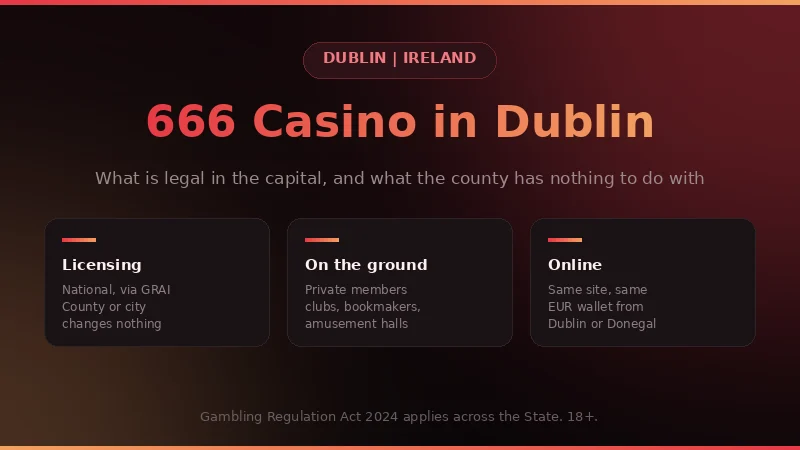
Dublin makes no difference to your online account. Irish gambling law is national — the Gambling Regulation Act 2024 and the GRAI apply identically in every county, and Dublin City Council issues no gambling licences. On the ground the city has private members clubs, bookmakers and amusement halls, but no commercially licensed casino, because Irish law has never created one.
Why the County Changes Nothing
This trips people up because in some countries it genuinely does matter. In Canada each province runs its own regime; in the United States it is state by state; in Germany the Länder had their own rules for years. Ireland does not work like that. Gambling is regulated by national legislation, and since the Gambling Regulation Act 2024 it is administered by a single body, the Gambling Regulatory Authority of Ireland.
There is one narrow historical exception and it is worth knowing about because it is the source of most of the confusion. Under the old Gaming and Lotteries Act 1956, a local authority could adopt or not adopt Part III of that Act, which governed amusement halls and gaming machines in its area. That is why gaming arcades exist in some towns and not others. It never applied to online play, it never created casino licences, and it is being superseded as the 2024 Act commences in phases.
No county permit
There is no Dublin gambling licence to hold, check or display. Anyone claiming one is confused or lying.
No local tax
Betting duty is a national charge on the operator's turnover. Nothing is added or deducted because you are in the capital.
No regional limits
Deposit limits, cooling-off tools and self-exclusion work the same in every county, because they are set by the operator under national rules.
The one place your address does matter is verification. Operators must confirm you are who you say you are and that you are in the State. That means the address on your account has to match the address on the document you upload, Eircode included. It is an identity question, not a licensing one.
What Dublin Actually Has
Ireland has never licensed a commercial casino. Section 4 of the Gaming and Lotteries Act 1956 defined unlawful gaming broadly enough to catch essentially every banked casino game, and licensed gaming was confined to amusement halls and funfairs. What grew up instead, mostly in Dublin, was the private members club: a venue that admits members rather than the public and operates outside the wording of that section. Around fourteen such venues were trading nationally by 2020, the majority in Dublin and its commuter belt.
Private members clubs
Table games, poker and machines, behind a membership sign-up. They are not prohibited, and equally they are not licensed as casinos — there is no register to check them against, and no regulator has historically supervised their game fairness. That gap is precisely what the 2024 Act was written to close.
Bookmakers
The most visible gambling premises in the city, and the most clearly regulated. Retail betting has operated under a licensing regime for decades, and it is moving under GRAI supervision as in-person licensing phases in from December 2026.
Amusement halls and arcades
Low-stake gaming machines under the old Part III regime, where the local authority adopted it. Stakes and prizes are small by design and bear no resemblance to online slot limits.
Racing and greyhounds
Leopardstown and Shelbourne Park sit inside the Dublin area, with on-course betting operating under its own long-standing arrangements. Culturally this is where Irish gambling actually lives, far more than any casino floor.
If you are comparing a members club against an online lobby, the honest difference is not the games — it is the paper trail. An online operator has published terms, a withdrawal policy, a complaints route and a licence somewhere you can look up. Whether that licence is Irish is a separate question, covered below.
Playing Online From Dublin
Everything is in euro. Deposits, balances, bonus values, withdrawal minimums — no conversion, no currency spread, which is one genuine advantage Irish players have over the UK-facing versions of the same brands. If a site quotes you a limit in another currency, you are on the wrong regional page.
Where things stand on the licensing side, as of the last check on this page: GRAI began issuing business-to-consumer remote betting licences on 1 July 2026, after opening applications in February. Remote gaming — which is what an online casino needs — has not opened yet; the Authority has said it is phasing licence types and is still working through transition arrangements with Revenue on gaming licences. In practice that means online casinos serving Irish players today hold licences issued elsewhere in Europe, not an Irish gaming licence, because no Irish gaming licence exists to hold.
Playing is not an offence for you either way. But it does change what "licensed" means when you read it on a casino page, and it changes where you can complain. Until Irish gaming licences are issued, your recourse runs through the operator's own regulator abroad rather than through GRAI. The register of Irish licensees is at grai.ie/register — if a site claims an Irish licence, that is where it should appear.
A note on the phrase "licensed and regulated". It is true of most operators and it tells you almost nothing on its own, because it never says by whom. The useful question is which regulator, and whether the licence number appears on that regulator's own public register. If a brand names a regulator but no number, treat that as an unanswered question rather than an answer.
Before and After the 2024 Act
| Area | Before | Now |
|---|---|---|
| Regulator | Split between Revenue, the Courts and An Garda Síochána | One authority, GRAI, established March 2025 |
| Remote betting licence | Revenue remote bookmaker licence | GRAI B2C licences issuing since 1 July 2026 |
| Remote gaming licence | Did not exist | Still does not exist; phasing not yet announced |
| Advertising | Voluntary codes | Statutory watershed and online opt-in rules |
| Self-exclusion | Operator by operator | National exclusion register provided for in the Act |
| Members clubs | Operating around the 1956 Act | Unchanged so far in practice |
The advertising row has its own page: what the watershed actually bans.
If Something Did Not Work
Address rejected at verification
Nine times out of ten the account address and the document address differ by a word — "Rd" against "Road", a missing apartment number, or a stale Eircode. Fix the account address first, then re-upload. Uploading a second document against the wrong address just adds a second rejection.
Card declined by an Irish bank
Several Irish banks block gambling merchant codes by default, and some let you toggle that in the app. That block sits on the bank's side, so the casino sees only a generic decline and cannot lift it. Check the card controls in your banking app before contacting the site.
Site loads differently than a friend's
That is regional page routing, not your county. Two people in the same street can land on different regional versions if one has a stored preference or is using a VPN. Clear the cookie and reload before assuming anything is broken.
A withdrawal is sitting in pending
Pending is the operator's own review window, before the money is ever handed to a payment provider. It has nothing to do with your bank or your location. Ask specifically whether anything is outstanding on verification, since that is usually what is holding it.
Getting Help in Dublin
Support in Ireland is national rather than city-based, and most of it is reachable from anywhere in the State. GRAI maintains a list of services on its own gambling safety pages, and gamblingcare.ie runs a free confidential helpline and funds counselling. Both are independent of any operator.
Before you need any of that, the tools on the account itself are the ones that work fastest: deposit limits, loss limits, time-outs and self-exclusion. Set them when things are calm. Every one of them is easier to switch on before a bad session than during one, and the cooling-off period on raising a limit exists for exactly that reason.
The 2024 Act also provides for a national gambling exclusion register, which would let one request cover every licensed operator rather than requiring you to exclude site by site. It sits alongside the licensing phases and is not yet operating.
FAQ
Is 666 Casino different if I play from Dublin?
Are there legal casinos in Dublin?
Does the county I live in affect my account or my limits?
Do I pay tax on winnings if I live in Dublin?
Is online casino play legal in Ireland right now?
What should I do if a site will not accept my Dublin address?
Are betting shops in Dublin regulated by the same body?
Keep reading: the advertising watershed · roulette tables and RTP · how we check all this
Same Rules, Wherever You Are
Set your limits, complete verification early, and keep the euro figures in front of you.
18+. Gambling can be addictive. Support and self-exclusion tools: gamblingcare.ie